
A first-hand account from two weeks at origin: three factories in Qingdao, and farm visits across Inner Mongolia and Xinjiang.
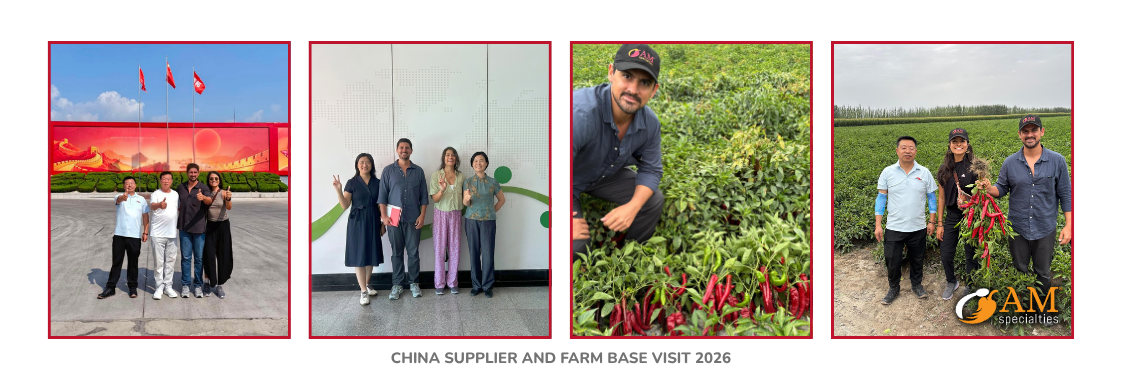
Every season, before we finalize sourcing decisions in a given region, someone from our team goes and looks at it directly, not from a spec sheet, not from a call, from the floor and the field. This season, that meant two weeks in China: three factories in Qingdao, then farm visits across Inner Mongolia and Xinjiang.
Qingdao: the factories
At each of the three factories we visited, we found current, upgraded equipment: new milling and packaging lines, and food safety controls built into daily operations rather than added on for the visit. All three run their own climate-controlled warehousing, which means raw material comes in at the right time for both quality and cost, instead of whatever happens to be available that week. Each also operates its own quality control lab on site, testing on their own schedule rather than shipping samples out and waiting on someone else’s timeline. For buyers, that combination, controlled storage plus in-house testing, is what keeps a batch consistent months apart, not just consistent on paper.
What stood out most though, wasn’t the equipment. It was the cleanliness, across the facilities and the people working in them. That’s not something a spec sheet or a sample can tell you. It’s the kind of detail that only shows up in person, and it says more about how a facility runs on an ordinary day than any scheduled tour could.
Inner Mongolia and Xinjiang: the farms
Out at the farms, what stood out first was how well-run things were. Most operations we visited kept solid agricultural practices, drip irrigation under plastic covering, which cuts water waste, improves fertilizer efficiency, and keeps weed costs down. The water itself comes from wells fed by snowmelt off nearby mountains, a detail that’s easy to miss on a spec sheet but hard to miss standing in the field.
But not everything we saw was reassuring. Sun-drying happens in open fields, with no covering, so the material sits exposed to insects, animals, and contamination during that stage. Once dried, it travels close to 3,000 kilometers, about four days, to reach the factories, still without temperature control, still exposed the whole way there. Neither of those is a dealbreaker on its own, but together, they’re the part of the chain where quality is most at risk of slipping between a good harvest and a good finished product, exactly the kind of detail that doesn’t surface until someone walks the route themselves.
What this means for how we source
China remains the strongest option we have on volume, price, and quality. This trip didn’t change that conclusion, it confirmed it, which is usually how these visits go: the decisions are made before the trip, and the trip is where we check our work.
It also showed us where to pay closer attention. We’re watching the handoff between drying and freight specifically, since that’s the stage where exposure risk is real even when everything upstream and downstream is running exactly the way it should. For buyers working with us on China-origin chile and paprika, that’s the kind of detail we’d rather flag proactively than have it show up as a quality question later.
We do this at every origin, every season, not because the answer is usually different, but because the only way to know it isn’t is to go and check.