
Why we source chiles from more than one country
A longer look at how origin diversification works, and why it’s more than a backup plan.
Chile sourcing is usually described by origin. Mexico for flavor & aroma, for example Guajillo, Chipotle or Ancho, India for heat using S4 or Teja, China for color as Paprika and Spain for specialties as Smoked Paprika. It’s a useful shorthand, and it tells you a lot about flavor, heat, and how a chile performs once it’s processed.
What origin alone doesn’t tell you is whether that supply holds up when conditions change, and that’s the part of sourcing we spend most of our time on.
The origins we work across
At AM Specialties, our chile sourcing spans from the U.S., Mexico, Peru, Spain, India, China, and several African growing regions.
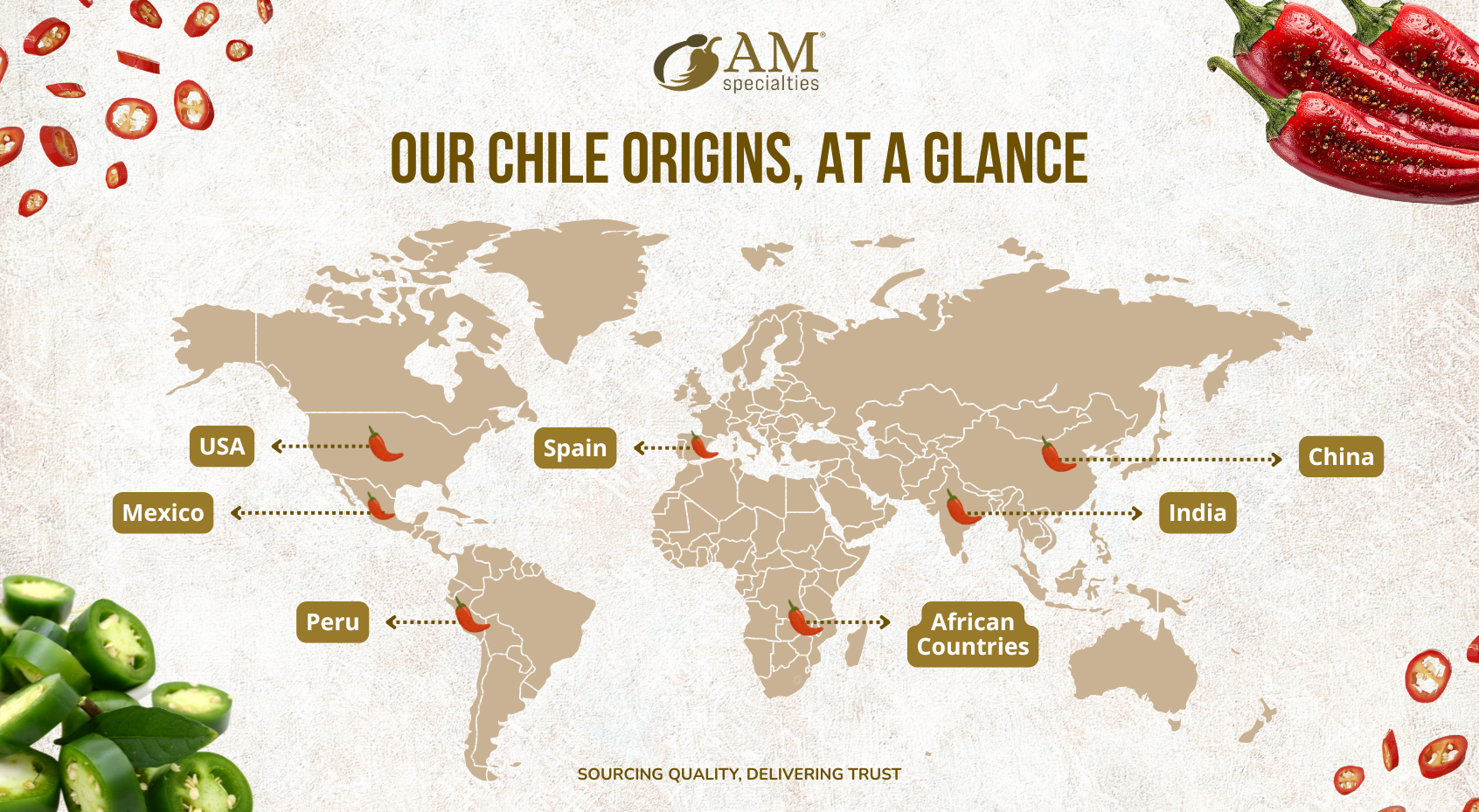
Each origin has its own strengths: a climate suited to a particular variety, an established processing and drying infrastructure, or a harvest window that complements another region’s off-season. Part of the sourcing work is knowing which origin fits which application, not just which one happens to be the cheapest this month.
Why one good origin still isn’t enough
Relying on a single origin works fine when conditions are stable. But conditions are rarely stable for long. A dry season can cut yield. A labor shortage can slow harvest and processing. An export policy change can restrict what’s allowed to leave a country, or make it more expensive to. Freight disruptions can add weeks to a route that used to be predictable. None of these are exotic risks, they show up somewhere in the world almost every season. The only real question is whether we’re positioned for it when it happens to be one of our origins.
A relationship that’s already warm
This is where a lot of sourcing plans fall short. Having a second country listed as a contingency isn’t the same as having a supplier there we actually know. A real backup origin means we’ve already visited, reviewed specs, run samples, and worked out pricing and lead times under normal conditions, so when something shifts, we’re not reaching for that relationship cold, in the middle of a shortage. We’re picking up a conversation that’s already been underway.
What we’re watching
Weather and harvest timing across each growing region. Export policy and any early signals of new restrictions or tariffs. Freight conditions on the lanes we rely on. Currency movement in origin countries, since it affects landed cost even when the crop itself is fine. This attention is really what keeps the relationships useful, it’s how we notice a shift developing before it shows up in someone’s order, rather than finding out after the fact.
What this means if you’re buying
The goal isn’t to source everywhere. It’s knowing, before you need it, which second or third origin could realistically cover a given ingredient, and making sure that relationship has already been built rather than started cold once a shortage is already underway.
If you’re reviewing how many real options sit behind your current chile supply, reach out and we can walk through what looks like for your categories.