
What This Harvest Season Is Actually Telling Us
Every season, buyers ask the same question: What do I need to know right now?
The honest answer is that knowing what’s happening is only the first step. What matters more is understanding what it means for your sourcing and what to do about it before the window to act closes.
We spend a significant part of our work year in ongoing contact with suppliers across India, China, Mexico, Vietnam, and other key origins before harvest reports are published, while crops are still in the ground.
What follows is our read on where things stand heading into the second half of 2026 across the categories we work with most closely.
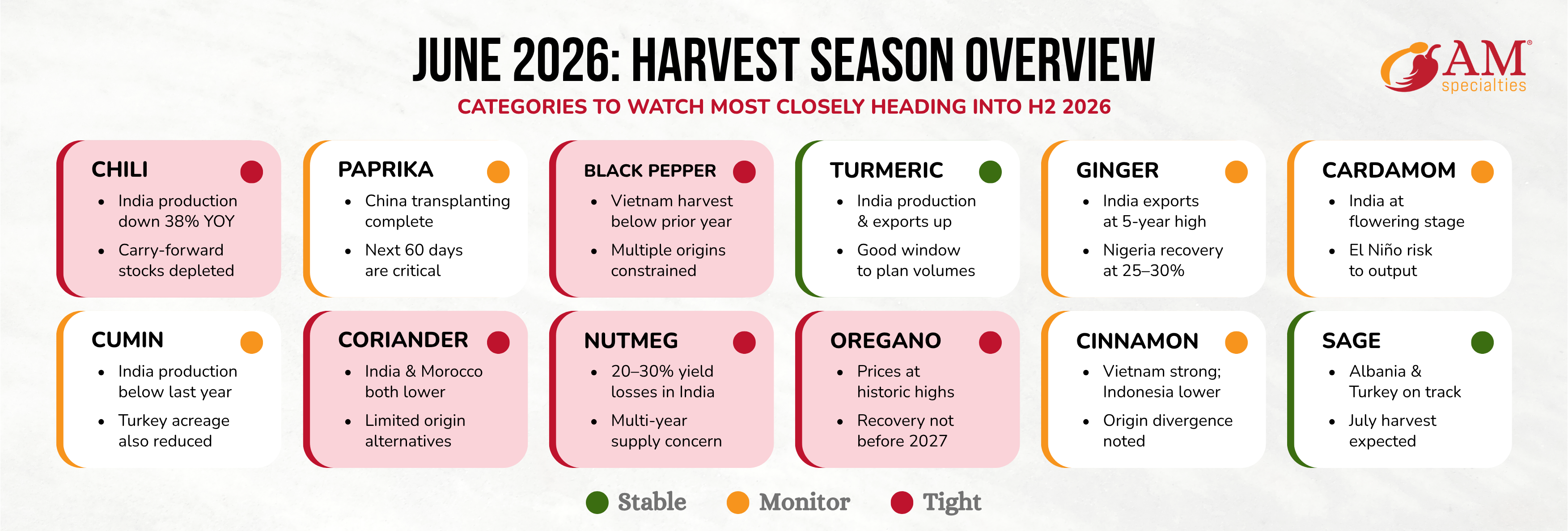
Chili: The Number Behind the Number
India closed this harvest season with production roughly 38% below last year. The market absorbed it without immediate disruption because carry-forward stocks filled the gap, but that buffer is now considerably thinner going into 2026–2027, and export volumes came in below the prior year.
In China, initial signals point to reduced acreage. Markets there are reopening after the standard summer break, and a clearer picture will emerge shortly.
A 38% production decline in the world’s largest chili-producing country deserves serious attention even when the surface looks stable. The supply available today is drawing from reserves that won’t be as deep next cycle.
Buyers still in the early stages of planning Q3 and Q4 volumes should be moving those conversations forward now, not after the market adjusts.
Paprika: A Quality Story Worth Watching
China completed transplanting under favorable conditions, and early acreage data is now coming into focus. Weather across the growing regions has been supportive so far, which is encouraging, but the crop is still early in its development cycle, and conditions over the coming months will be the real factor.
Prices out of China are currently stable.
China is the origin that drives the paprika market, and this is the window where the season’s direction starts to take shape. Stability now doesn’t guarantee stability later. Any significant weather shift between now and harvest will move the market.
If paprika is a key ingredient in your portfolio, staying close to how the Chinese season develops over the next 60 days is worth the attention.
Black Pepper: Tight Across More Than One Origin
Vietnam’s harvest came in below the prior year, and farmers are holding stock rather than selling, a behavior that tends to slow available supply in the near term.
Indonesia is looking at a lower crop, with new arrivals not expected until August–September, and Brazil’s new crop faces logistical uncertainty on major export routes.
When farmers are holding in one origin and alternatives are also running below expectations, there’s less room to maneuver than the headline numbers suggest.
Right now, understanding which origins your supplier can actually execute from—not just offer—matters more than usual.
Turmeric: One of the Steadier Stories
India delivered a stronger turmeric season, with production and exports both running ahead of the prior year. Prices consolidated through the peak arrival window without the sharp correction some expected.
Indonesia’s new arrivals are beginning to come to market, though reduced acreage is expected to limit that contribution.
Turmeric is one of the calmer stories in an otherwise complex season. For buyers with turmeric in their portfolios, this is a relatively stable window to plan volume with reasonable visibility.
Locking clarity into a category that isn’t creating urgency frees up bandwidth for the ones that are.
Ginger: Supply Up, but Nigeria Is Still a Factor
India’s production came in slightly above last year, and exports reached a five-year high, partly driven by a crop failure in Nigeria that shifted global demand toward Indian supply.
Nigeria’s 2026 harvest has improved but remains at only about 25–30% of pre-blight levels.
Indian supply is absorbing the demand gap well for now. But Nigeria’s recovery trajectory is something we track closely. A meaningful improvement there could shift global dynamics relatively quickly, and it’s worth keeping in the background of any longer-term ginger planning.
The Crops Worth Watching Closely
Cardamom
Indian plantations are at the flowering stage, and progressing El Niño conditions with forecasts for below-normal rainfall introduce genuine uncertainty for this season’s output.
Guatemala’s harvest came in above last year on volume but with quality concerns around density.
The flowering stage under El Niño pressure is exactly the kind of early-cycle signal that gets underweighted by buyers focused on current pricing. Yield and quality decisions are being made right now in the field, and the outcome won’t be fully visible until harvest.
Worth a proactive conversation with your sourcing team.
Cumin
India’s harvest closed below last year on production, though higher carry-forward stocks supported total availability.
Turkey also reduced cumin cultivation as farmers shifted toward more profitable alternatives.
The Turkish acreage reduction is driven by economics, not weather, which makes it more predictable but also slower to reverse.
Farmers who moved to other crops don’t necessarily come back after one improved season. It typically takes a few cycles to rebuild meaningful acreage, and it’s a dynamic we’re watching across several spice categories right now.
Coriander
Indian production came in below last year, and lower carry-forward stocks have tightened total availability further.
In Morocco, a key secondary origin, acreage is estimated at around 15% below last season following unfavorable weather, and harvesting has recently gotten underway.
When two primary origins tighten at the same time, the standard contingency of switching origins isn’t as available as it normally would be.
Buyers counting on that flexibility in the second half of this year should confirm whether it’s actually there before they need it.
Nutmeg
India is dealing with meaningful yield losses from splitting and shedding, compounded by heat-related tree mortality.
Sri Lanka’s production is running significantly below normal, while demand remains strong.
The part that concerns us most is the structural dimension. Nutmeg trees take years to mature, so losses this season affect supply in 2027 and 2028, not just 2026.
For customers with nutmeg in their formulas, building contingency now before tightness becomes undeniable in the price is a more practical position than reacting later when options have narrowed.
Oregano
Turkey’s 2025 harvest fell sharply with no carry-forward stocks, driving prices to historic highs that have persisted into 2026.
The current season is expected to come in slightly above last year’s depressed output, but new plantation acreage won’t contribute meaningful volume until 2027, and elevated labor costs are keeping processor prices high.
The pattern we’ve seen over the past year is consistent: buyers waiting for a meaningful correction ended up paying more the longer they waited.
Our read for the rest of 2026 is the same: the improvement is real, but partial.
Cassia Cinnamon
Vietnam’s first harvest phase delivered well this season.
Indonesia has dealt with persistent rainfall expected to reduce overall production.
The divergence between the two origins this season is a useful reminder that sourcing cassia from a single origin carries more risk than it can appear.
Having established supplier relationships across both is what allows you to adapt when conditions split, and this season is a good example of why that matters.
Sage
Albania and Turkey are both tracking toward July harvests under currently favorable conditions.
In Albania, inflation and a stronger local currency against the USD are keeping processor prices elevated independent of crop performance.
The currency and inflation dynamic in Albania is a cost driver that doesn’t always make it into market summaries, but it has a consistent and real effect on what buyers end up paying.
Freight and Currency: The Variable Layer
Logistics costs remain elevated and difficult to forecast.
Freight pricing is being driven more by geopolitical risk, Red Sea disruptions, and vessel rerouting than by traditional supply-and-demand dynamics.
The Indian Rupee remains under pressure against the US Dollar, adding a cost layer for anything sourced from India.
Where you have flexibility to build in more lead time, use it. The buyers absorbing the most disruption right now are those still planning on the same timelines as two years ago.
That’s a straightforward adjustment that doesn’t require waiting for conditions to stabilize.
What This Season Is Asking of Buyers
This is not a crisis season, but it’s one where several categories are tightening simultaneously, carry-forward stocks are thinner than they were, and the logistics environment compounds the picture.
The buyers who will navigate the second half of 2026 most effectively are the ones acting now: confirming volumes, verifying backup origin options, and adjusting lead times rather than waiting for conditions to clarify further.
That’s the work we do alongside our customers at AM Specialties.
If any of the categories covered here are part of your sourcing portfolio, we’d welcome the conversation.
AM Specialties sources capsicum, chiles, spices, herbs, and dehydrated vegetables globally, with a focus on supply consistency, quality, and long-term supplier relationships.
Contact us here