
Behind the Ingredients: What Happens to New Mexico Chile After Harvest
Every fall, the New Mexico chile harvest reaches the point where the story stops being about the field and starts being about supply. Harvesting slows down, the last pods come off the plants, and the crop moves into drying, grinding, and packing. That transition is starting to happen now, and this year it’s worth paying closer attention than usual.
New Mexico growers planted similar acreage compared to last year and early reports over the summer were optimistic. But the season didn’t hold. In a mid-September statement, the New Mexico Chile Association said supply shortfalls this year would run between 20% and 30%, depending on the product and the supplier. For buyers who source New Mexico chile in any form, fresh, frozen, dried, or ground, that’s the number to plan around heading into 2027.
How the season played out
The trouble started early. A warm winter carried into a hot March, and the heat encouraged an early hatch of leafhoppers, which spread curly top disease through fields across the Hatch Valley. Many fields still managed a normal first pick. What they wouldn’t do was recover enough to produce the second harvest growers were counting on.
From there, the season compounded. Growers reported more than 30 days above 100°F this summer, well past the conditions chile actually prefers, which is closer to 90°F in the day and 65°F at night. Once temperatures climb past that range, plants need more water just to hold on, and the added irrigation brings more disease pressure with it. Add persistent drought and heavy insect pressure, and the result was a season several growers described as one of the hardest they’ve seen.
The impact wasn’t uniform. Some operations came through in reasonably good shape. Others lost a large share of their acreage to the disease and heat. That spread across farms is part of why the association’s estimate is a range rather than a single number, and it’s also why blanket assumptions about “the New Mexico crop” won’t tell a buyer much. What matters is the specific supplier and the specific product.
Timing shifted too. Green chile is finishing earlier than usual this year, with some growers expecting to be done by the end of September, weeks ahead of the normal season-ending frost in mid-to-late October.
Red chile is a different story: those pods stay on the plant to fully ripen, so red harvest continues right up until frost. As of late September, suppliers were still working through fields to determine exactly how much red chile they’d be able to bring in.
From field to finished ingredient
Once chile is picked, it doesn’t go straight into a bag or a jar. For chile headed toward drying, whether that’s flaked, powder, or a seasoning blend, it moves through a defined process, and each stage of that process is where a buyer’s specifications get built.
At a processor like our partner Seco Spice, the path looks roughly like this:
- Receiving and traceability: incoming chile is assigned a lot number that ties it back to the grower, the harvest date, and the point of origin. This is the foundation of traceability: without it, a “New Mexico chile” claim is just a claim, not something that can be verified back to a farm.
- Sorting, grading, and washing: pods are graded, washed, and sliced before moving further into the process. Grading is where quality gets separated out. What doesn’t meet standard doesn’t continue on to the dryers.
- Drying: tunnel dryers and belt dryers use controlled heat to remove moisture. This step is where the moisture percentage on a spec sheet gets set, it’s one of the first numbers most buyers check.
- Milling and grinding: dried chile is ground into flakes or powder. Some processors can mechanically remove stems and seeds first, which produces a more vibrant, brighter red color. Grind size, from coarse flake to fine powder, is determined by the mill settings at this stage.
- Sterilization: before shipping, spices typically pass through a steam sterilization step for microbial reduction. Steam sterilization is notable because it’s approved for certified organic products, unlike some other reduction methods.
Some processors also hold large flakes in cold storage rather than milling everything right away. That protects color and pungency and gives them flexibility to adjust grind size closer to when a customer actually needs the product.
What a short harvest means downstream
None of this changes because the crop was short this year, but the short crop changes what’s moving through it. Fewer pounds harvested means fewer pounds going through the dryers and mills this fall, and less total product to draw on through the rest of the year.
For a buyer, that makes the questions to ask a supplier more specific than “do you have chile.” Worth asking directly: what moisture level can they hold consistently on this year’s lots, what color and grind options are actually available, and how far back their traceability records go. A supplier who can answer those in detail is one who’s staying on top of a tighter crop rather than just hoping it stretches.
Looking ahead to Q1 2027
Industry sources expect the effects of this year’s shortfall to reach store shelves and, by extension, manufacturers, by the start of the next year, with tighter supply and higher prices. Firm lead times are hard to pin down right now because suppliers themselves are still finalizing how much red chile will come in. The New Mexico Chile Association has urged processors and buyers to have those conversations with suppliers directly rather than waiting.
If chile is part of your sourcing plan for next year, a few things are worth doing now, before allocations are set:
- Confirm volumes and delivery windows directly with your supplier.
- Review where your spec actually has room, whether that’s color, grind, or form, so you’re not locked into the tightest possible version of the product.
- If a second origin could work for your application, request samples now rather than after supply tightens further.
A note on Seco Spice
This spring, we spent time with the Seco Spice team in southern New Mexico during transplanting season. Their seedlings start out in a nearby nursery greenhouse before making the trip to the fields, where they’re placed into the ground using a semi-mechanized transplanter built to keep planting consistent across several different pepper varieties at once. We saw their organic Scorpion, habanero, pasilla, and ancho crops at that early stage.
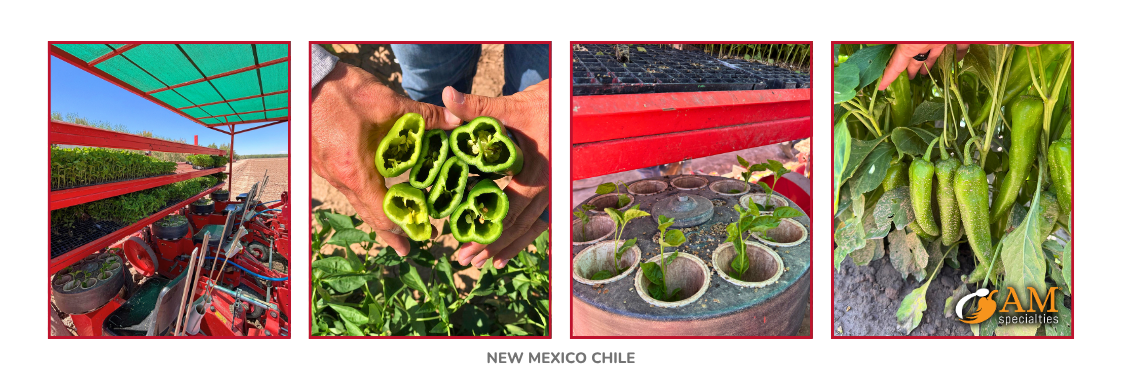
Seco is a family-owned farm and processing operation with more than 20 years in the business, and they manage the crop from seed all the way through to finished ingredient. That full-circle involvement is what allows us to trace organic capsicum we source through them back to the specific field it came from, not just a region or a co-op.
If New Mexico chile, or a backup plan for it, is part of your sourcing conversation for early 2027, we’re happy to talk through timing, forms, and what we’re seeing from growers and processors on the ground.