
When people talk about sourcing in our industry, the conversation often starts with origin.
Paprika from Spain. Garlic from China. Peppers from Mexico. Origin matters, of course.
It tells you a lot about flavor profile, availability, quality expectations, and how an ingredient might perform.
But origin alone does not tell you whether supply will hold up when conditions change. And that is where sourcing becomes more complex.
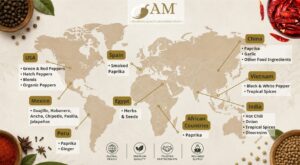
The map above shows part of our global sourcing network and the regions we work with across different ingredients.
But what matters most is not just the number of countries on the map. It is the structure behind it.
For us, that starts with diversification.
Relying on a single origin for a key ingredient can work well when conditions are stable. But agriculture is rarely that simple. Weather shifts. Harvests vary. Freight changes. Demand moves quickly.
When that happens, the question is not only “Where can we buy this?”
It becomes:
- Do we have another reliable option?
- Do we understand the differences between origins?
- Can we protect continuity without compromising quality?
That is why multiple sourcing options are not just a backup plan. They are part of building a stronger supply model from the beginning.
It also means staying close to origin.
Not just knowing where something comes from, but understanding how each region behaves, how harvests are developing, and what conditions could affect supply later in the year.
Those details matter because sourcing issues rarely appear all at once.
They usually build quietly first, through crop conditions, timing, pricing pressure, logistics constraints, or quality variation.
The earlier you can see those signals, the better you can plan around them.
And just as importantly, sourcing needs flexibility.
Markets move. Prices fluctuate. Customer needs change. A sourcing model that looks good on paper still needs to work in real operations.
That is why we do not look at sourcing as a fixed map. We look at it as an active network that needs to stay balanced, responsive, and practical.
The visual above captures the geography.
What it does not show is the ongoing work behind it: the relationships, the market awareness, the planning, and the decisions that help supply hold up across changing seasons and conditions.
At AM Specialties, sourcing is not just about connecting origins. It is more about building supply strategies that can perform over time.
If you are reviewing your sourcing approach or simply want to exchange perspectives on how others are navigating today’s supply challenges, always happy to connect.